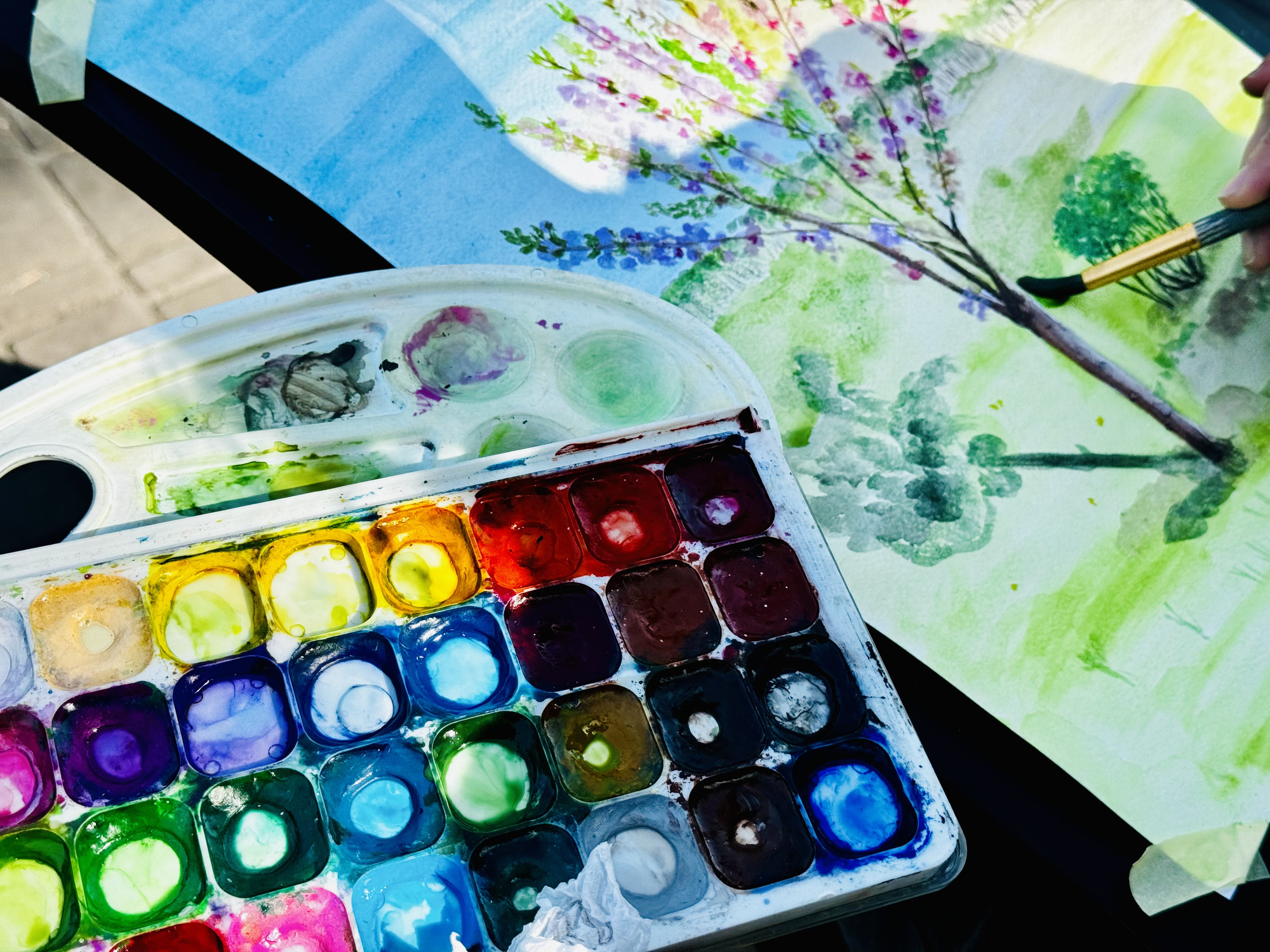
Nature and Art

Required Book:
“Painting Nature: Techniques, Tutorials and Projects”; Gemma Koomen; Quadrille; ISBN 978-1837832750
(All Books Can be purchased at Brewster Book Store)
Suggested Books:
- “Botanical Watercolor Painting for Beginners: A Step-by-Step Guide to Create Beautiful Floral Artwork”; Cara Olsen; Page Street Publishing; ISBN 978-1645675921
- “Wildflower Watercolor: The Beginner’s Guide to Painting Beautiful Florals”; Sushma Hegde; Page Street Publishing; ISBN 978-1645676775
- “Thinking in Watercolor: A Daily Practice to Unlock Your Creativity & Discover Your Inner Artist”; Jessie Kanelos Weiner; Artisan; ISBN 978-1648293320
- “Watercolor Mixing Deck: Landscapes”; Charles Evans; David & Charles; ISBN 978-1446316726
- “Watercolor Mixing Deck: Architecture”; Charles Evans; David & Charles; ISBN 978-1446316719
- “Charles Evans’ Watercolour Rescue: Top tips for correcting your mistakes and preventing them in the first place”; Charles Evans; Search Press; ISBN 978-1782219422
- “Charles Evans' Pocket Book for Watercolour Artists: Over 100 Essential Tips to Improve Your Painting”; Charles Evans; Search Press; ISBN 978-1782216377
Recommended Supplies:
Highly Recommended:
- Smartphone camera
- Journal with watercolor paper (cold press)
- Soft pencil (HB, H, or #2)
- Pencil sharpener
- Technical drawing pen
- Refillable brush pen
- Colored pencils (watercolor pencils work well)
- Watercolor set (Art Toolkit)
Optional:
- Backpack or shoulder bag
- Binder clips
- Small ruler
- Small mixing palette
- Small sponge
- Small rag
- Small water bottle
- Small water spray bottle
- Small syringe (no needle)
- White gel pen
- Color wheel
- Small hand lens or magnifier
May 4, 2026 – 10:00 - 12:00 am – Nature and Art – Brewster Book Store
Description: This workshop invites participants to explore the natural world through observation, artistic expression, and gentle scientific curiosity. Designed for adults interested in watercolor, nature journaling, and creative exploration, the series blends art practice with insights from ecology and visual perception. Participants will slow down, look closely at the landscapes and objects around them, and learn how color, light, and form in nature can guide the creative process.
Unlearning creative anxiety begins with letting go of the need to get it “right.” Many artists carry quiet expectations shaped by comparison, past criticism, or the pressure to produce something meaningful every time they create. This process invites a shift—from performance to exploration—where mistakes become information, and uncertainty becomes part of the practice. By returning to curiosity, play, and attentive observation, artists can loosen the grip of self-judgment and reconnect with the simple act of making. In this space, creativity is no longer something to prove, but something to experience.
Topics Covered:
- How to closely observe natural objects using all senses
- Creation of simple sketches focused on line, shape, and pattern
- Experimenting with mark-making rather than aiming for finished drawings
- Deeper understanding of perception and observation
- Construction of a personal visual journal of nature studies